

Where Visibility Breaks Down: Why Growing Businesses Lose Sight Before They Lose Control
Aug 10, 2026
Growth doesn't always announce the moment a business becomes harder to see.
There is rarely a single meeting where the CEO realizes:
We no longer have enough visibility into what we're building.
Instead, the signals tend to appear gradually.
A question about profitability takes longer to answer than it should.
A hiring decision feels harder to make with confidence.
Revenue is increasing, but cash doesn't seem to be moving with it.
A department appears productive, but no one can clearly explain what that productivity is producing.
The CEO begins hearing different versions of the same story depending on who is asked.
There are dashboards.
Reports.
Meetings.
Accounting systems.
CRMs.
Project management platforms.
Spreadsheets.
KPIs.
And still, something feels unclear.
This is one of the most misunderstood realities of growth:
A business can have more information than it has ever had and less visibility than its leadership actually needs.
That's where the Visibility Gap™ begins to matter.
Because when a business becomes more complex, the question is no longer simply:
“Do we have the information?”
The more important question becomes:
“Can we see what the information is trying to tell us?”
Growth Creates Distance
In the early stages of a business, the founder is often remarkably close to everything.
You know the customers.
You know what's being sold.
You know who owes money.
You know which projects are behind.
You know what employees are struggling with.
You may even know the bank balance without opening the banking app.
That proximity creates a form of informal visibility.
But growth changes the relationship between the leader and the business.
More customers create more transactions.
More employees create more communication.
More services create more operational variation.
More systems create more places for information to live.
More revenue creates more financial decisions.
More opportunity creates more competing priorities.
Eventually, the founder can no longer see the business simply by being close to it.
And this is where something important happens:
The business must transition from visibility through proximity to visibility through structure.
If that transition doesn't happen fast enough, complexity begins moving faster than the leader's ability to see it.
That's when visibility starts breaking down.
Visibility Rarely Breaks Everywhere at Once
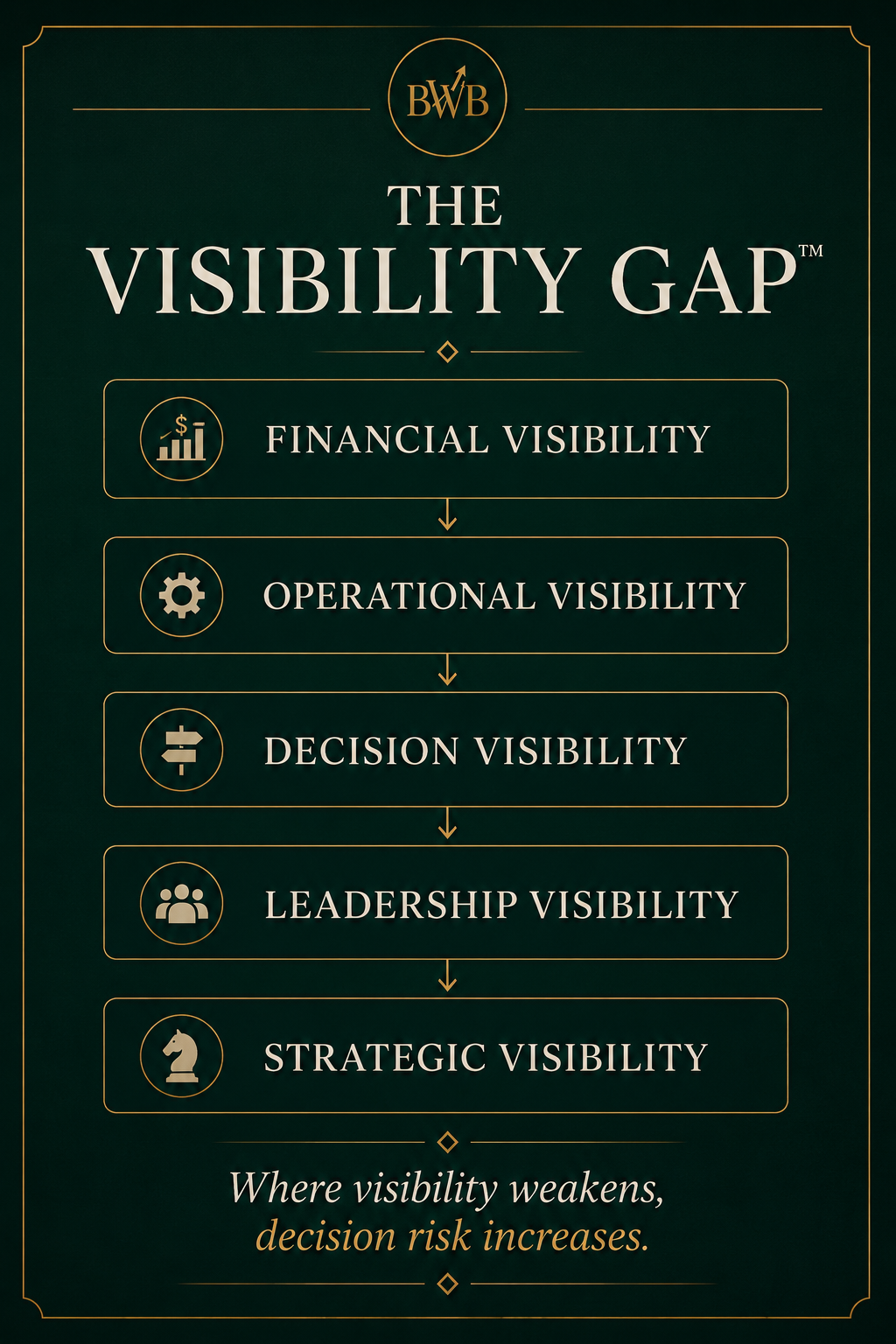
A Visibility Gap™ doesn't necessarily mean the entire business is unclear.
That's what makes it easy to miss.
A CEO may have excellent revenue visibility but poor profitability visibility.
They may understand the company's financial position but have limited visibility into operational capacity.
They may know what happened last month but have very little visibility into what is beginning to change now.
They may have strong departmental reporting but weak visibility across departments.
Or they may have access to every number imaginable while still struggling to determine which numbers deserve executive attention.
The business can therefore appear highly sophisticated from the outside while leadership is quietly making decisions through incomplete information.
And the danger isn't always immediate failure.
Sometimes the greater risk is something far less dramatic.
A good decision made too late.
An opportunity you didn't recognize.
A margin problem you didn't see developing.
Capacity you assumed you had.
A cost that quietly became structural.
A customer concentration risk nobody noticed.
A team problem that appeared operational but was actually financial.
A profitable-looking offer that consumes more resources than leadership realized.
A growth opportunity that should have been declined.
Visibility gaps don't simply hide problems.
They can hide possibilities.
And that's why visibility is not merely an accounting issue.
It's an executive issue.
The Five Places Visibility Commonly Breaks Down
As businesses grow, I've found it useful to think about visibility across several interconnected dimensions.
Not because every company experiences the same problems.
But because asking where visibility is weak is far more useful than simply asking whether leadership has “enough data.”
1. Financial Visibility
The numbers exist.
But can leadership interpret what they mean?
Financial visibility goes beyond knowing revenue or checking the bank balance.
Can you see:
- What is actually driving profitability?
- Where margins are changing?
- Which revenue is creating value?
- Where cash is being absorbed?
- Which financial trends deserve attention before they become problems?
- What the business can realistically afford to do next?
Financial reporting tells you what happened.
Financial visibility helps you understand what it means for the decisions ahead.
2. Operational Visibility
A business can appear busy while leadership has surprisingly little visibility into how work actually moves.
Projects are being completed.
Employees are working.
Customers are being served.
But where is the friction?
Where are delays occurring?
Which processes depend too heavily on one person?
Where is capacity constrained?
What breaks when volume increases?
Operational visibility becomes increasingly important as the founder moves further away from day-to-day execution.
Because what appears to be a people problem may actually be a process problem.
And what appears to be a process problem may actually be a capacity problem.
You cannot address the right problem if you cannot clearly see where it originates.
3. Decision Visibility
There is another layer that receives far less attention:
Can leadership see why decisions are being made?
What information informed the decision?
What assumptions were made?
What risks were considered?
Who owns the outcome?
What would cause leadership to reconsider?
Without that visibility, companies can accumulate decisions without accumulating organizational intelligence.
The same conversations happen repeatedly.
Old assumptions survive longer than they should.
Different leaders make decisions from different versions of reality.
Eventually, leadership isn't simply managing the business.
It is managing competing interpretations of the business.
4. Leadership Visibility
Growth can also create distance between leadership and what employees, customers, and operations are actually experiencing.
Executives may receive summarized information.
But summaries can remove context.
By the time an issue reaches the CEO, it may have passed through several layers of interpretation.
This doesn't mean leaders should insert themselves back into every operational detail.
Quite the opposite.
The objective is not greater involvement.
The objective is better line of sight.
Leadership needs enough visibility to recognize patterns, ask better questions, allocate resources, evaluate risk, and make informed decisions—without becoming the operating system of the company.
5. Strategic Visibility
Perhaps the most consequential visibility breakdown occurs when leaders become so consumed with operating the business that they lose sight of where the business is going.
The calendar fills.
Problems get solved.
Customers are served.
Revenue comes in.
Meetings happen.
But the strategic questions receive less attention:
What are we actually building?
Which opportunities deserve resources?
What should we stop doing?
Where are we becoming unnecessarily complex?
What does the next stage of the company require?
What risks are forming beneath today's performance?
A company can therefore become extremely efficient at moving while becoming increasingly uncertain about whether it is moving in the right direction.
The Most Dangerous Visibility Gap Is the One You Don't Know Exists
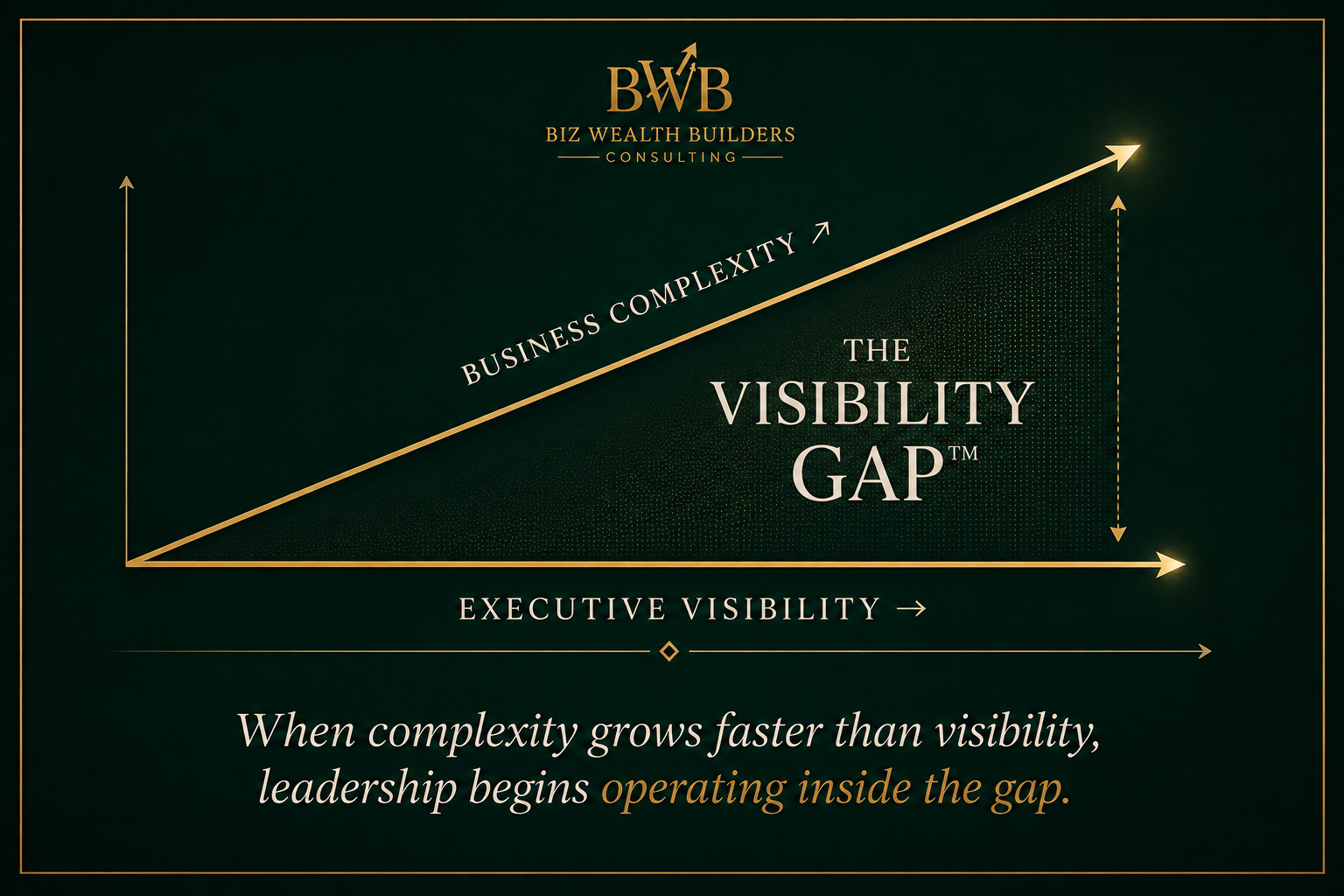
Known problems can be investigated.
Known weaknesses can be strengthened.
Known risks can be evaluated.
But an invisible problem doesn't create that opportunity.
You cannot investigate the question you haven't thought to ask.
You cannot prepare for the constraint you cannot see.
And you cannot intentionally pursue an opportunity you don't recognize.
That's why I believe one of the responsibilities of executive leadership is not simply knowing more.
It is continually improving what the organization is capable of seeing.
Because as the business grows, the cost of operating with incomplete visibility grows with it.
The decisions become larger.
The resources involved become greater.
The number of people affected increases.
And the window for responding to certain problems—or opportunities—can become smaller.
Growth doesn't automatically create better visibility.
In many cases, it does the opposite.
It creates more places for visibility to break.
A Question Worth Asking This Week
Don't ask:
“Do I know what's happening in my business?”
That's too easy to answer.
Instead, ask:
“Where am I still making assumptions because I don't have enough visibility?”
Look at your finances.
Your operations.
Your team.
Your customers.
Your capacity.
Your decisions.
Your strategy.
And pay particular attention to the questions that take longer to answer than they should.
Those questions may be showing you exactly where your Visibility Gap™ lives.
Because the goal isn't to know everything.
The goal is to see enough of the right things to lead well.
And the leaders who develop that ability earlier have an advantage:
They have more time to respond.
More time to protect what they've built.
More time to recognize opportunity.
More time to strengthen the business before pressure forces the decision.
More time to choose rather than react.
That time matters.
Don't Wait Until Growth Exposes What You Couldn't See

The conversations inside Legacy Leaders Collective™ are designed for founders, CEOs, business owners, managing partners, presidents, and established consultants who understand that the next stage of growth often requires more than another tactic.
It requires perspective.
The kind that can help you see the question you haven't asked yet.
Recognize the assumption you've been operating from.
Hear how another leader is approaching a challenge you're beginning to encounter.
And build relationships with people thinking seriously about what it means to grow well.
You can wait until complexity forces those conversations.
Or you can enter the rooms where they're already happening.
Join Legacy Leaders Collective™ and be part of the conversations shaping what comes next.
Because sometimes the most expensive thing in business isn't making the wrong decision.
It's realizing too late that there was something you couldn't see.